Americans must start asking themselves some serious questions. As it stands now, we are once again poised to do nothing more than hand the reins of power from one corrupt party to the other. We will keep fighting amongst ourselves while the victors continue to push and support the same policies people believe they are voting against. The spending will continue, the infringements against personal liberty will get worse, as will the advancement of the AI super-surveillance state. We are a society that has become so beat down and immersed by propaganda, very few of us can distinguish a lie from the truth or even recognize that we are being propagandized at all. This is because people fail to understand the nature of propaganda in its entirety, or they assume only the other side is being propagandized. The techniques of propaganda and manipulation are so advanced and refined in their understanding of psychology and sociology people have no idea what they are dealing with. According to Ellul (p.89), it is the massive studies into the psychological make up of human society, and the unconscious processes of the brain that make propaganda possible at all. These studies have been taking place for nearly a century or more. While politically active Americans pride themselves for staying informed through the mass media, their reactions and opinions are thoroughly examined so they can be better influenced or persuaded. The understanding of human behavior, and its relation to techniques of propaganda is so advanced, there is little to no chance the reasoning capacity of the average man will be able to see through them (Ellul, p. 109).

Jacques Ellul was a French philosopher, sociologist, legal historian, and Christian theologian best known for his analysis of propaganda, political power, technological society, and the loss of individual freedom. He taught at the University of Bordeaux and wrote extensively about how modern institutions shape the way people think, behave, and understand the world. Ellul is especially relevant to understanding political propaganda because he argued that propaganda is much more than government officials telling lies. It can become an entire social environment that shapes public opinion, group identity, and people’s perception of reality.
While there are many definitions of propaganda, Edward Bernays’ is perhaps the most fitting. He defines it by saying “the purpose of all propaganda is to mold the minds of the masses so they will direct all of their efforts toward the desired ends of the shadow government, who use the powers of propaganda to gain approval on issues that at one time, would have been opposed.” It can’t be stated enough that the powers of propaganda he is referring to are nothing more than a thorough understanding of human behavior. One aspect of behavior that makes men susceptible to propaganda of all kinds is our need to belong to something bigger. An article entitled Defining Propaganda: A Psychoanalytic Perspective, describes propaganda purely from this viewpoint. Discussing Erich Fromm’s theory of symbiotic relations, Laskin (2020) says that propaganda is essentially a means of convincing people to sacrifice individualism for the goals of something bigger. Symbiotic relations is a means of merging the self with something that gives meaning to life. Religion is one example, however, Laskin (2020) also states that political parties fit the bill just as well. People willingly allow themselves to get caught up in the rhetoric of their chosen party for several reasons. One, because the party line is a carefully constructed narrative that reflects the attitudes, opinions and preconceived biases of party members. Two, Fromm discusses the idea that people need a sense of belonging that stems from the feeling of being isolated and alone in the world. Being a part of a group that stands for something perceived as being important supports a positive sense of personal identity. It also makes people susceptible to propaganda, as this overinflated self-perception can become a controlling mechanism.

Erich Fromm (1900–1980) was a social psychologist, psychoanalyst, and philosopher who examined how human beings relate to one another, how people respond to freedom, and how social systems can encourage conformity and submission.
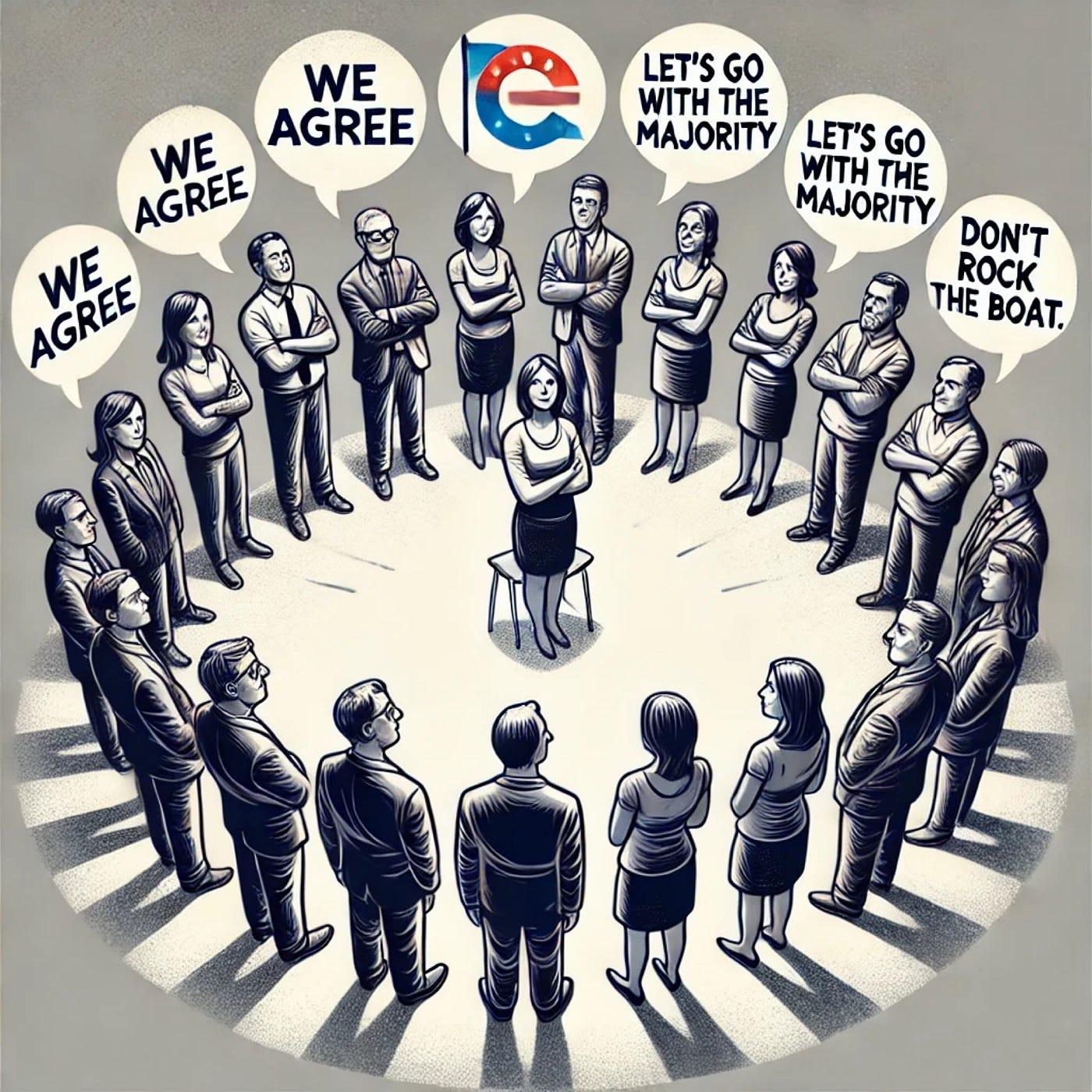
In fact, according to Ellul (p. 94) propaganda can only work when a man’s behavior is already influenced by the group he belongs to. Looking at things from the perspectives of what he calls a mass society, which a political party could be considered, people are much more easily manipulated and further detached from reality when in a group. They cling to the party line, becoming more susceptible to groupthink while having their identity defined by the party they belong to. What is groupthink? It is a phenomenon that affects the decision making and consensus seeking processes of a group that “typically operates under directed leadership, experiences high levels of stress, has low self-esteem, and has little hope of finding solutions to a pressing problem other than that favored by their leader” (Turner and Pratkanis, 1998). Times of stress and uncertainty create a need for belonging, a desire to conform, which is often driven by one’s own lack of understanding, or fear of being alone. This desire to fit in also leads to self-censorship, which is another characteristic of groupthink. People, out of fear of being shunned by the group, willingly suppress their own thoughts, opinions and ideas as they place group membership above themselves. Finally, there is a shared belief that the group possesses an inherent sense of morality that rises above the moral views of other groups.
“Propaganda makes use of this individual human need to be a part of something. It uses a need in symbiotic relations, creating meaning in human life, at the same time, reaching its own purpose; in other words, people are often happy to be brainwashed.” (Laskin, 2020)
Republicans and Democrats both display groupthink type behavior. Both surrender their own personal identity for group membership, while holding their definition of morality as being superior. Members of both parties think they are fighting for the betterment of the country, and because of this, they surrender their own individuality for the group. Donald Trump supporters, for example, attached themselves to the idea of defeating the deep state and restoring American principles. This is the belief binding the group together, creating what Turner and Pratkanis (1998) calls collective rationalization, making them susceptible to any propaganda that pushes this message. Democrats are the exact opposite. They see American principles as the problem and are dedicated to the fight for social justice. Their illusion of morality is based on the ends justifies the means mentality, as they see their end goal as a better society for everyone, and even demonstrate a willingness to corrupt themselves to achieve it. Both of these scenarios represent something that is bigger than life, creating a deep sense of purpose for the people involved. They become driven by what Ellul (p. 94) calls intense but fleeting emotions. People are easily aroused and led from one issue to the other, without ever having any true resolution. We see this take place every day as the news media continually exposes us to stories that keep us in a state of cognitive overload.
Americans need to ask themselves if they understand what propaganda is, and if they realize their susceptibility to it. Most people simply cannot understand that their passion to contribute to something bigger, a better America, or social justice, a restored second amendment even, are what makes them prime targets for propaganda. When people lose touch of their individuality and choose to self-censor for the sake of conformity, they are allowing the progression of corruption. For example, Donald Trump was able to get away with increasing the national debt by twelve trillion dollars, and many other things, because questioning it resulted in shunning and isolation from group belonging. People who went against the group consensus were ridiculed and heckled as never-Trumpers or liberal hacks. Most people opted for belonging as opposed to facing that kind of scrutinization, considering that a fear of being alone, or the unknown, is what likely brought them into the group in the first place. This concept applies equally to the Democrats as well. Until Americans decide to study what it is known about the subtleties of human behavior, and how it is applied to propaganda, we will never get out of this mess. Manipulative leaders will be able to stand in front of their audiences and mock them for their loyalty, and their supporters will remain clueless. This is because they have no idea that their attitudes, opinions and beliefs have been analyzed and studied so they can be led exactly where the propagandist wants to take them. Into a state of mindless, non-questioning compliance.
Enjoy this content?
Be sure to check out my latest book! The Psychology of Persuasive Propaganda: The Things You Should Know.

Check these out as well.
Without a Shot Indeed: Inducing Compliance to Tyranny Through Conditioning and Persuasion.

and A Critical Look at CRT in Education, Research and Social Policy

Copyright 2026. This is the intellectual property of David Risselada and defenseofournation.com


