
It is hard to find opinions about the latest news that go beyond the paradigm of the left vs. right political conflict raging in our country. Whether you get the news from a so-called Republican outlet or a Democrat source, it is most likely driven by the primary agenda of gaining or retaining political power and keeping us sitting on the edge of our seats. Stories will always be framed to either demonize and discredit, present someone as a hero, or frighten us into compliance. The information presented to us is coming faster than ever before and from more sources than we can possibly keep up with. We are constantly bombarded with images, memes, and messages meant to influence our perceptions, and keep us rooted on one side of the aisle or move us to the other. While many Americans tend to fancy themselves as astute political thinkers, very few consider the ramifications of exposing themselves to constant media that these days, seems to do little more than bring distressing, and often traumatic, anxiety inducing news. Is it possible that the powers that be are deliberately working to keep the American mind overwhelmed with stories of a world on edge and out of control? Are they employing a deliberate strategy of information overload? The book, Media, Persuasion and Propaganda states that information/cognitive overload makes the public easier to manipulate. Is this true?
Just over the past week, we have been told that President Trump has reached a peace agreement with Iran, after threatening to blow them into oblivion. It wasn’t even a total of thirteen hours before that peace plan collapsed and we were being told it was a misunderstanding of the terms. Some sites are reporting, no doubt in an attempt to build on growing frustrations towards Trump, that he haphazardly accepted the terms of Iran’s ten-point plan in an effort to declare a much-desired victory to a war that should have never happened. This plan explicitly included the halting of Israeli operations against Lebanon. One minute the straight is open, the next it is closed. We went from a defeated Iran within the first few hours of the war, to what others are now calling a complete capitulation to Iran’s demands. On top of all of that, we have Melania Trump, on her own accord, holding a press conference declaring she had no relationship whatsoever with Jeffrey Epstein. Why? This is a direct contradiction to the claims that President Trump made calling the whole thing a hoax. As of Sunday, April 12, alleged peace talks with Iran have failed, even though we have already defeated them. With all of the conflicting information being presented, how does anyone know for sure what is going on?
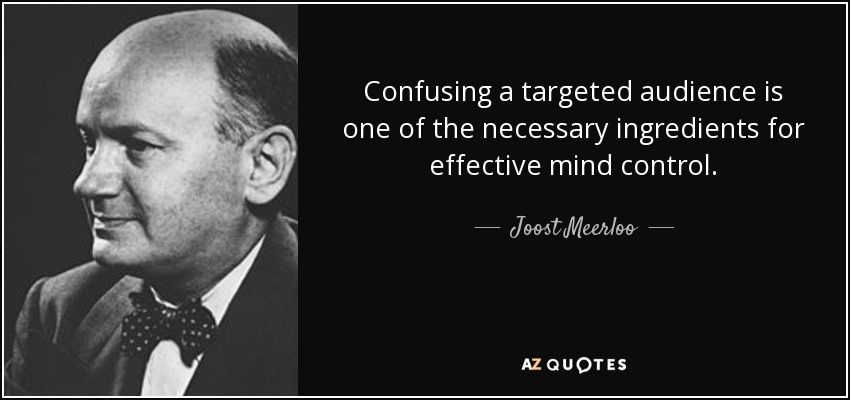
Joost Meerloo, in The Rape of the Mind, describes this type of unending, incessant propaganda as a totalitarian strategy of no political rest. It is a type of mass terror campaign in and of itself meant to keep the public in a constant state of discontent, unrest and anxiety, unsure of what to think about the current state of affairs, or what might happen in the future. An article entitled The Impact of Anxiety upon Cognition: Perspectives from the Human Threat of Shock Studies, defines the term Pathological Anxiety as the “persistent and debilitating apprehension about negative future events that can affect cognitive performance.” Is everyone in America at the point of debilitating apprehension? Not necessarily, however, debilitating effects that affect cognition can be as simple as easy distractibility, a diminished ability to concentrate, and a loss of short-term memory. This type of stress can have a positive effect in terms of behavioral change as it may induce a heightened awareness of potential danger. However, constantly being in this state begins to wield these negative effects as well. It is safe to say that the American public is experiencing some type of stress from the constant propaganda being fed to us a continuous basis. Whether it is war, economic problems, corruption in government, mass shootings, or threats of a new pandemic, we are being kept in a state of shock.
These sentiments are amplified in another article entitled, Psychological Trauma Through Mass Media: Implications for a Current Pandemic-Infodemic Situation. This article examines the relationship between media propaganda and psychological trauma during the good old Covid days. According to the authors, this type of trauma, induced through incessant propaganda, can deplete a person’s sense of self-control. Psychological trauma is defined as a “feeling of helplessness in the face of frightening or dramatic events.” It could be argued that the media is keeping the public in this state of mind as everything is presented from a doom and gloom perspective. In the past few months alone, we have witnessed the Charlie Kirk assassination, the Epstein files, and the war in Iran. All situations which the public feel completely helpless to do anything about. Yet, in many cases, people are anxiously chomping at the bit, waiting to be told what to believe or that the government is coming to save them. An article at Deltapsychology.com states that the need to be constantly aware of what is going in the world can at once be an addiction, and something that creates a fight or flight response. It is the stress and anxiety that an individual may become addicted to. Echoing the sentiment from the previous article as well, Delta Psychology states that being in this state of mind diminishes a person’s self-control, making them easier to manipulate, as they “become highly susceptible to over-simplified narratives.” What is an over simplified narrative? Trump is draining the swamp, is one example. We won the war in the first couple of hours, is another. These are narratives that reflect the deeper, ideological underpinnings of the Trump voting base. To them, he can do no wrong, and everything fits within the “he is our only hope” framing. It isn’t different with Democrat narratives, by the way. Democrats are easily swayed by the same simplification of narratives that reflect their desires for some hero to save them from the evils of capitalism. Trump just happens to be at the helm at the moment.
Americans become attached to media narratives that reflect their views, opinions and cognitive biases because they care about the country. It is safe to say that statement applies equally to people on the right and left despite them having completely different visions. We are easily manipulated because these narratives are deliberately targeting our emotional dispositions knowing the effects it has on our cognitive functioning. According to another article entitled Overloaded Circuits: Why Smart People Underperform, people suffering from information overload may develop a condition called Attention Deficit Trait. While this sounds similar to attention deficit disorder, it is different in the sense that it is driven primarily by the fast-paced environment in which we live, and the constant consumption of what the authors call “feckless information that amounts to nothing.” That is exactly what the media continues to feed us—information that ultimately, never goes anywhere. ADT diminishes our abilities to pay meaningful attention to anything. In fact, it could be suggested that people experiencing information overload may not be able to pay attention to anything except that which reflects their views simply because it is easier than exerting any cognitive effort to learn something different.
In this article we looked at four different sources that all support a commonly held view that information overload diminishes our self-control, makes us easier to manipulate and hampers our ability to pay meaningful attention to anything. If these are the known results of being exposed to too much stressful information, you have to ask yourself why the media is constantly bombarding us with not only too much, but often very contradictory information as well. I think the answer is self-evident.
If you enjoyed this article, be sure to be looking out for my latest book, The Psychology of Persuasive Propaganda: The Things You Should Know, where I discuss this topic and many more, coming soon. In the meantime,
Without a Shot Indeed: Inducing Compliance to Tyranny Through Conditioning and Persuasion.

and A Critical Look at CRT in Education, Research and Social Policy


